
20 Years of Innovation: The History of Source Audio (Part 1: 2006 to 2010)
My my, how time does fly! Believe it or not, in 2026 Source Audio is celebrating its 20th anniversary. Over the years we've taken some chances, made some mistakes, and learned some lessons. We also had a great time, met a ton of amazing musicians, and created some killer effects pedals. Through it all we've always stayed true to our Tradition of Innovation.
“I’ve been maniacally obsessed with innovation since day one. Now and then, that means we release ideas before the world fully catches up. I’m okay with being early—because that mindset has fueled 20 years of creativity at Source Audio.”
-Roger Smith (Source Audio President)
Usually we spend our time looking forward and thinking about what's next for Source Audio, but just this once, we want to look back over the past 20 years and share with you the many highs and occasional lows of our long journey. We hope you find it interesting and educational. Class is in session!!
2006
Released in 2006: Hot Hand Motion Controlled Wah Filters
Let's go back to the beginning! Source Audio was originally conceived as a collaborative effort between four musicians/engineers from two iconic Massachusetts-based companies: Analog Devices and Kurzweil Music Systems.

The Source Audio Founders: (L to R) Bob, Roger, Hunter, and Jesse
The idea initially took root when Source Audio founders Roger Smith and Jesse Remignanti were still working for semiconductor giant Analog Devices Inc. in Wilmington, Massachusetts. Analog Devices is a major force in digital signal processing. They are particularly well known in the music equipment industry for developing the SHARC processor, a DSP used in basically every high-end digital effects pedal you know. Roger had an idea involving a new microprocessor being developed by ADI called Sigma DSP. He knew that it could be a perfect processor for guitar effects. It had excellent sound and was mega-powerful!
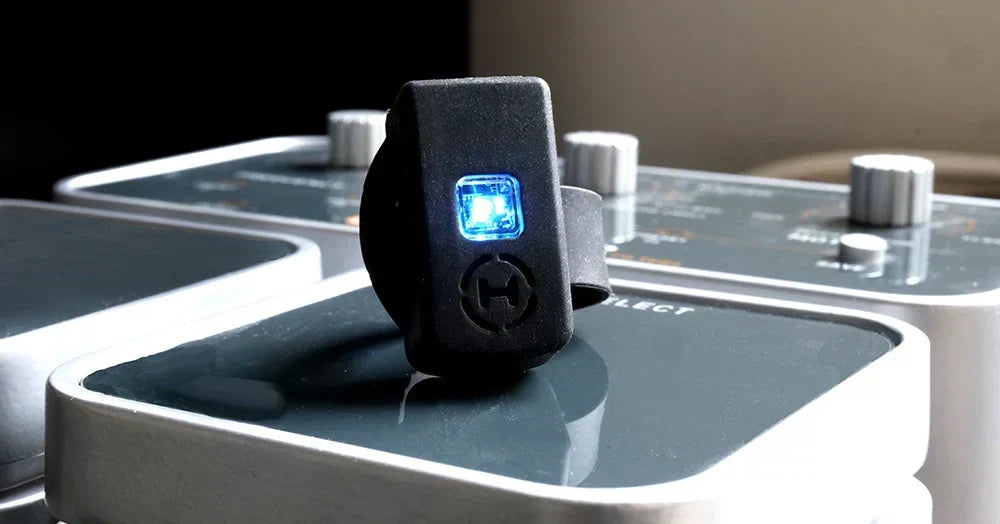
Roger's colleague, Jesse Remignanti, was a young engineer at ADI. Jesse also had a guitar related idea that was tied to ADI technology. At the time he was working on a project that involved accelerometer technology and thought that it could be a very unique and expressive way to control effects pedals. Similar to how a Cry Baby Wah pedal moves a filter to create its effect, an accelerometer can also move a filter, but do it far faster and more naturally than an expression pedal ever could. So by summer of 2006 Roger and Jesse left ADI to start Source Audio. Yes, they were leaving the company but it was very clear to them that Analog Devices would still play a major role in their future.

The Hot Hand Ring
They had a great idea, but they still needed some additional help, so Roger called his long-time friend and fellow music lover Hunter Boll and asked him to come on board as a business partner. It seems there's more to starting a pedal company than just dreaming up crazy, innovative sound making devices! Hunter had a business acumen second to none with over two decades of experience as the managing director of Thomas H. Lee Partners, one of the largest private equity firms in the world. Hunter would become essential in getting Source Audio off the ground and keeping it in the air.
The final piece was an unbelievably talented sound designer named Bob Chidlaw. Previously, Bob was one of the head engineers at Kurzweil Music and played a major role in the development of the legendary Kurzweil K2000 synthesizer. The K2000 was famous for its variable architecture synthesis technology which lets users build signal chains from the ground up—choosing oscillators, filters, shapers, and DSP blocks in flexible orders. This approach will probably sound very familiar to those of you who have experience using vintage modular synthesizers and, of course, Source Audio's C4 Synth. But we're getting ahead of ourselves!
SA 601 Sigma DSP

Right after leaving Analog Devices, Roger and Jesse immediately started working with their former employers to co-develop the SA601, a specialized version of ADI’s renowned Sigma DSP. The Sigma SA601 is a proprietary processor that serves as the engine behind the stellar sounds that come out of Source Audio pedals. By the end of 2006 Source Audio was ready to release the Hot Hand Motion Controlled Wah Filter, a radically different approach to effects pedals. It combined 10 exceptional sounding filters that could easily be modulated with the expressive motion control of the Hot Hand Ring. The guitar world had never experienced a pedal quite like this.
A very early demo of the Hot Hand Phaser/Flanger
2007
Released in 2007: Hot Hand Phaser/Flanger w/ Wireless Ring
The following year Source Audio released the Hot Hand Phaser/Flanger as well as a wireless version of the Hot Hand Ring. Originally Hot Hand required a hard-wire connection to the pedal, but that soon proved impractical for the stage, so the wireless version was born.
 The Hot Hand Phaser/Flanger
To everyone that we talked to, Hot Hand sounded like a slam-dunk idea. There is no doubt that an animated guitar player controlling filter and phaser effects by waving a wireless ring had the power to turn heads, but ultimately the world of guitar players was not yet ready to put their money down on such radical new technology. Unfortunately, Source Audio's first couple of years were not as successful as expected.
2008
Released in 2008: Soundblox Tri-Mod Wah, Soundblox Tri-Mod Phaser, Soundblox Tri-Mod Flanger, Soundblox Multiwave Distortion
 The Soundblox Tri-Mod Wah
Following slow sales of the Hot Hand Wah and Phaser/Flanger, the team went back to the laboratory and came up with a new approach. The Soundblox line of pedals made its debut at the 2008 NAMNM Show. Bob Chidlaw delivered more exceptional tones and also explored an extremely innovative approach to distortion called multi-band processing. The Soundblox Multiwave Distortion brought to life an idea originally proposed by Craig Anderton, the co-founder of Electronic Musician magazine. Craig imagined a distortion unit that could split a guitar signal into 4 discrete frequency bands and run each one through its own distortion circuit. Bob took this idea and pushed it to extremes, splitting the signal into as many as 10 separate frequency bands. The result is an especially thick and articulate distortion sound that needs to be heard to be fully understood and appreciated.
The SB Multiwave Distortion may have been a bit too far outside the realm of tradition to gain universal appreciation, but it was very quickly embraced by a small but enthusiastic group of forward thinking guitarists. The list of early adopters for the Multiwave includes Adrian Belew, Reeves Gabrels (guitarist for The Cure and David Bowie), Steven Wilson of Porcupine Tree, and Earl Slick (guitarist for John Lennon and David Bowie)–all of whom still turn to the Multiwave's one-of-a-kind tone. In a recent Guitar.com interview Reeves Gabrels called out the Multiwave as one of the "Five Pieces of Gear I Can't Live Without."
2009
Released in 2009: Soundblox Pro Multiwave Bass Distortion, Soundblox Pro Multiwave Distortion, Soundblox Pro Classic Distortion.
Following the modest success of the new Soundblox line of pedals the team quickly started thinking about ways to improve. What followed was the Soundblox Pro line. Soundblox Pro added some great new features including 6 presets accessible with 3 footswitches, an 8-band graphic EQ, and full MIDI functionality.
Soundblox Pro also marked Source Audio's first foray into the world of bass effects, where we quickly established a special relationship with the bass community–a relationship that's still going strong in 2026. Bob Chidlaw had discovered that multi-band distortion sounded fantastic with bass guitar. The Soundblox Pro Multiwave Bass Distortion offered a vast palette of distortions that range from thick drive with an articulate and punchy bottom end, to soaring octave effects, to synth-like foldback distortions.
Will Cady Demos the Multiwave Bass with a Daft Punk Cover
2010
Released in 2010: Soundblox Bass Envelope Filter, Soundblox Multiwave Bass Distortion, Soundblox Classic Distortion, Soundblox Pro Classic Distortion
Several Soundblox and Soundblox Pro pedals were released in 2010. Most notable was the Soundblox Bass Envelope Filter. It was the first of many bass filter pedals that Source Audio would release over the years. Immediately the BEF and its 24 different filters became a hot topic on bass forums like TalkBass.com. The pedal's beautifully natural envelope response combined with its ability to produce all flavors of filter–from classic Mu-Tron and MXR Bass Envelope Filter sounds to vowely multi-peak filters–soon established Source Audio as one of the elite companies in the realm of bass filter effects.
Of course we couldn't rightly call this article, "The History of Source Audio" without including the "Slurple Gurp" demo from Will Cady. This Soundblox Pro Bass Envelope Filter demo is probably Source Audio President, Roger Smith's favorite video of all time. Enjoy...
The fire was lit. Source Audio was starting to attract attention, but there were still many mountains to climb, many rivers to cross. To be continued...
CONTINUE READING "20 YEARS OF INNOVATION: THE HISTORY OF SOURCE AUDIO (PART 2: 2011 to 2015)"

Leave a comment
This site is protected by hCaptcha and the hCaptcha Privacy Policy and Terms of Service apply.